

Updated: Apr 20
Cathartes anófthalmos
Birds - Old Wives' Tales - West Virginia
Field Guide Contents

THE CASE OF CRANBERRY GLADES
The Proboscis Bird is a kind of vulture native to the Cranberry Glades of West Virginia. From a distance, its silhouette is hawk-like; it is identifiable by its broad, short wings; featherless, fleshy, beak-less and red-ish head; an ornamental, "V"-shaped, feather mohawk around the neck; brown coloration; and overwhelmingly foul smell. Juveniles have fluffy white heads and lose their youthful plumage as they mature. A blind species, the Proboscis Bird depends on smelling (and a little hearing) to find food, mates, and its nest. Due to human activity, they are presumed to now be extinct in the wild.
A QUICK GLANCE
Height: up to 20 in tall

Wingspan: up to 3 ft (0.91 m)
Coloration: brown, gray
Discovered By: Agent Roman
Popularity Status: Largely Unknown
Other Names: Sightless Swamp Vulture, Stink Bird, Nose Bird
Learn about Proboscis Birds on the go!
EUROPEAN EXPLORATION
The Sightless Swamp Bird was first documented by 18th-century European explorers in the Cranberry Glades of Pocahontas, West Virginia. These explorers were both fascinated and repelled by the bird's unusual appearance and strong, unpleasant odor. Initially believed to be valuable for their easily obtainable meat, feathers, and skin, these birds were captured, handled, and studied. However, the human interaction had devastating effects on their population, as it disrupted their scent-based social structures.
Today, the Proboscis Bird is a rare and seldom-seen species, largely known only to cryptozoologists and bird enthusiasts. Nearly extinct in the wild, they are conservation dependent.
Information on the Proboscis Bird stems from a 18th century journal; it was recovered from the expedition team's surviving members, none of which were the book's author. The book was once on display, but has not been seen since 1963; it is suspected to have been misplaced, stolen, or damaged beyond repair and disposed of.
MADNESS OF THE MOUNTAIN
Loud, heavy boots trekked down the mountainside, the ground cragged and gritty with sandstone. Gear clanged and rattled, the noise bouncing down into the valley, announcing the party’s invasion. Deer and rabbits fled while squirrels and birds watched from their perches. A turkey vulture followed above. Crossing over this chain was no easy feat, and the exploration team was exhausted and marred by misfortune. Once 60 men strong, they numbered less than 30, losing several along the way to illness, violence, and bad luck. Most unfortunate was the loss of their guides, who simply disappeared two weeks prior, and the team’s expert frontiersman, only two days ago. Concerns heightened. The expedition, or perhaps the land, was cursed. Thomas Fallam, leader of the party, was also experiencing some malady. Outwardly in good health, with no injuries or symptoms, he never seemed to sleep. He was seen and heard rummaging through the camp at night, staring down into a fire, or standing alone in the woods. It was feared he was coming down with the ‘madness of the mountain’, an illness believed to develop in some who breathe in air from high altitudes. They could only watch and hope the signs abated over the course of their descent.
Drawn by rich forests, abundant wildlife, the anticipation, expectation of discovery and wealth led them here. In what is now called the Allegheny Mountains, the land peaks at 3,400 feet, gradually sloping into a valley; nearly 300 miles from the nearest settlement, it would be an understatement to call the trek challenging, even for an experienced, well-equipped team. Expeditions once cut through Virginia to find nearby access to the Pacific Ocean, later to support England’s claim over the territory, and, now, to increase the English' s presence and survey for settlement.
A strong, refreshing breeze occasionally whipped up towards them. While it made it harder to walk down, it felt wonderful, cooling them off on their trek into the lowlands. Dressed in wools, the men were usually hot or cold, but never comfortable. They dressed in baggy coats, thinner waistcoats, stockings, and tall, stuffy leather boots. While the material kept a body warm in the cold, there was nothing one could do in the heat but remove layer after layer. And, when wet, the clothing became heavy.
The lower and lower they walked, the thicker and more humid the air became. The next day was even more terrible. Weighed down by their attire, further down, they encountered sloshing mud. Their surroundings morphed from a dense forest to a bog; a stream cut through their path, then another. The ground became slicker and tacky, the unavoidable mud gripping and pulling boots right off the foot. The water pooled around their ankles, then calves, saturating them entirely, irritating and hurting their skin. There were no attempts at drying–and no hopes of temporary relief for the rest of the day. The pleasant breeze died, which added boiling in the humidity to their list of complaints. The night was barely tolerable. Fallam wandered in a circle around camp; the rhythmic, yet occasionally erratic, slap of his bare feet put the men on edge.
Finding good footholds the next day was a struggle. The earth was just as soaked as they were, squishing and squeaking with each step, fizzling with water like a wrung sponge. The mosses built tall knolls that were easily tripped over, reaching 3 feet high in some places; the vibrant, bubbly tangle of vegetation and rock was tied in place and smothered by vines and bushes. Before them, in the distance and under the setting sun, was a beautiful sea of gently swaying wildflowers, herbs, and grasses in yellow, orange, and green speckled with bright white and red.
Seeking a place to camp, they settled on a small, somewhat dry hill under a sprawling swamp maple; the area was littered with clusters of broken sticks, little bones, and long-lost feathers, The debris was not a welcome sight. Something had been here and attacked–and likely more than just once, counting all of the bones. While the carnage looked far from fresh, the possibility that whatever made it could still be somewhere, hidden in the vast bog, was not a welcome consideration.
There was also a smell; the valley, though lovely to look at, emitted a foul aroma, like putrid vegetables and fish. The hill somehow smelled even worse than the disturbances released earlier in the mire with each muddy stomp. Fallam, with an unblinking, wild, wide-eyed stare, smiled as the party discussed whether to go back or forward, whether they should spend the night elsewhere. Concluding the debate, he insisted they should stay, as he would like “a chance to see what kind of beast might do such a thing.”
The team built a small fire, cooked leftover game, and argued over watch; no one felt much like sleeping, even though their weary bodies demanded it. The roar of insects was an eerie combination of new sounds and a few familiar ones. The sway and windy jerk of grass and leaves teased invisible creatures and possibly concealed real ones’ movements. The firelight played tricks, creating the reflective glint of nonexistent eyeballs and shadowy figures. And the smell—it never let one feel at ease, always returning with a new, acidic, deathly edge.
The journal recounted many thoughts and fears of an imagination run amuck: the undead waiting on the scummy swamp bottom, crawling up from the water once they gave in to sleep; a giant serpent in the tree, posed to strike with its mouth spread wide and breathing heavily; a slinking, diseased, evil panther circling the mound, plotting how to take them down one-by-one. Fallam sat near a fire, his eyes fixated on the darkness.
Leaning against a tree and never quite falling asleep, one noted a shift in the atmosphere late that night. A breeze picked up and cut through the bog, smacking into the camp along the way; the scent it carried was beyond foul. Sickened, he fell on all fours. Senses overwhelmed, head spinning, mouth-watering, he tried to hold his nose and keep his meager dinner inside. Pallid, his eyes rose slowly, leveling with the field's pointed, woozying top. The air stilled once more, but in the distance, just out of the firelight's reach, the bog was rustling. Not the way the wind would rustle it but the way something walking through it would. Frightened into a stillness, he held his breath once more, fingers quivering, legs tight springs. A musket sat a few feet away; he grabbed it. There was nowhere to run. And yet, that is what Fallam did; sprinting towards the movement, he disappeared into the night.
More shaking appeared in the grasses, but not in the same place. The movement was all around and the general stench of the air intensified. Splashing, squelching, wet sounds encircled the hill, as did muted thumpa-thumps. He called out, expecting a mad Fallam, but received no response.
A clawed foot reached from the field. It hung above the moss, slowly splaying out and down, squishing into the green. Another claw breached, attached to a long, stick-like arm. A round body bobbed up and down in a rhythm of three quick movements. The creature's head was tucked into itself; feeling the air upon it, it stretched, exposing a wrinkled gullet with tufts of hair scattered over it like a nearly bald head. A long line of fur was upon its back, standing on end and pointing out in two directions like a bat's wings frozen mid-flap. It stared up at the author, sending a shiver down his back; it had no eyes, only a long rectangular head of melty, rumpled skin. The flesh on the tip of its face inflated into a ball, hissing and deflating in a puff of air. The animal shined in the firelight; a brown ooze dripped from its body and trailed down its legs, gathering bits and pieces of what it traveled through.
Undoubtedly, this creature was the source of the hill's bad smell. It walked forward with hesitant movements, its head twitching up and down, its bulbous nose inflating, deflating. Frozen, he recounted watching the creature as a shout sent the camp into chaos. Its face tilted upward, it gave a deep sniff and flapped two heavy wings before rushing forward and into his arm. Scared, he scuttled backward, hitting his back against the tree. The thing had fallen, as well, landing awkwardly on its back; it rolled around, righting itself after a slight struggle. It shook, puffing its feathers out, then continued forward, unbothered. Looking around frantically, he realized the things were coming into the clearing in hordes. The explosive sound and acrid smell of gunfire surrounded him. Clumps of the things fell in heaps. Yet, the creatures ambled forward.
From all sides, the beasts stepped onto the hill, walking over corpses of their brethren, towards the fires, sniffling loudly. One broke from the shrinking circle, a beeline into a burning pit. As the flames hit, it honked, thrashing wildly, flapping, kicking, and snorting. Another ran, and another, and another. They clinked against a cook pot, the fifth attack sending it rolling downhill. The birds sizzled and smoked and fluttered around; their honking stopped most of the shooting.
The sniffling restarted, a loud, audible wave; the birds changed course, some running for the tumbling pot. Others began charging those who had caught on fire or were shot, pecking and tearing at their flesh hungrily.

THE EXPEDITION RETURNS
Killing a massive amount, they then captured every bird that had wandered in or near their camp. The animals were unafraid of humans initially, but also couldn’t successfully evade capture even when they tried. Throwing together a makeshift pen, the animals were drawn in and corralled over the course of several weeks. It seemed that the more birds they had nearby, the more newcomers were drawn in. Building larger and larger pens, they set trap boxes and lures, the birds an unending stream of intrigue and food. The little camp was surrounded by hundreds of stinking birds by the weeks’ end: from old, nearly featherless elders to fuzzy, yet mostly bald chicks. The hatchlings were easiest to work with; less than 6 inches long, and even less intelligent than their parents, they ate anything presented to them and did not mind poking, prodding, or handling as much.
Unusually docile at night, as the sun rose, they grew more aggressive. They pecked at hands, feet, faces, anything in reach, with a sharp, one-toothed beak that was hidden under their fleshy nose; surprisingly strong and vicious, the attacks left deep, painful wounds. Aside from pecking, they would relentlessly hiss and screech, as well as violently thrash around. The “Stenchbird” was decidedly butchered at night to avoid these unpleasantries.
Easy to make into a meal, the birds’ aromatic, tough meat tasted as disgusting as it smelled. Conserving their supplies, they suffered through countless portions of the bird, half-heartedly searching for their missing leader. The creatures’ feathers were foul and coated in an unpleasant oil. While they could have been implemented as stuffing or quills, their scent and feel would persuade few to use them if any alternative was presented.
In fact, this smelly oil was an overall issue. Tainting meat, feather, and skin, the secretion and its smell clung to clothing, gear–everything it touched. Spread by hands, utensils, work spaces, and the birds, it made both the skin rashy and stomachs sickly. Before they could begin to figure out a way to circumvent it, an evil descended upon the birds: they were increasingly cannibalizing each other, even with various feeds being provided.
After a month, with the search for Fallam unsuccessful and the animals’ strange behavior a sign, the expedition made the decision to pack up and return home while they could. The bulk of the birds were exterminated; others were slain for provisions. Only four men survived the trip back.

"We’re in the swamps of West Virginia, looking for a specific primate-like animal, but have stumbled across something unexpected, something few in modern times have laid eyes on. It is so rare that people believe it has never even existed, living only in myth. It is not a dangerous monster, like so many we have tracked down, though, it is so unpleasant some might categorize it as mildly so. At this distance, you’d need binoculars to get a good look, being a medium-sized creature, but even from here, if you squint and focus, you’d be able to see a brown blob slowly wobbling through the grasses, low to the ground– you’d smell it long before seeing it. Called one of the ugliest and smelliest birds to have ever lived, the Proboscis Bird, the Stinkbird, or, more commonly, the Sightless Swamp Vulture, is nearly extinct."
- BCwPA Field Journal
The Proboscis Bird hadn't been seen in the wild since 1897. While presumed extinct for nearly 130 years, against all odds, one little group still persists in the Cranberry Glade, and a BCwPA Team was fortunate enough to observe and document it.
WHERE DOES IT LIVE?
These birds can only be found in one location: the Cranberry Glades of Pocahontas, West Virginia. This is a 750-acre bog characterized by dense forests, muddy areas, and a network of streams.
The birds prefer areas with tall grasses and thick vegetation. In the summer and fall, they can be found in the central region of the swamp. During the winter, they venture to the edges, taking shelter in dense foliage or hollow trees. There, they build temporary sleeping nests.

WHAT DOES IT LOOK LIKE?
THE HEAD The Proboscis Bird has an elongated, rectangular head covered in a thick, wrinkled skin. Here, it is mostly barren of feathers; often dirty and coated in oils, beneath hides an almost pretty, reddish-brown color (less vibrant than the infamous turkey vulture). The head ends in a pronounced, bulbous nose covered in thin, translucent hairs. A very sensitive organ, the birds can pick up smells over a mile away. It can also inflate and produce numerous honking sounds. Hidden beneath the nose is a formidable, toothed beak. While it appears to lack eyes, they are hidden under folds of loose skin. The eyes are, however, mostly useless, only able to detect dramatic changes in light.

NECK Around the neck, the vulture's plumage is sparse. Tufts of hair-like feathers are scattered across its wrinkly gullet; the strands help the bird 'see', detecting objects and orientating the animal. Sensory feathers like these are found elsewhere on the body. Along the back of the neck is a double-mohawk of long, thin feathers in a "V" shape; these are only exhibited during moments of stress or aggression, like a dog raising its hackles.
BODY The Proboscis Bird's body is a collection of mottled brown features and a stout, robust skeletal-muscular structure. Their feathers are waterproof, coated in a natural oil: a brown, foul-smelling ooze called 'Glade Syrup'. The substance is sticky, collecting loose vegetation, discarded feathers, and other debris. The unpleasant taste and scent of the oil decentivizes potential predators from eating them - and other organisms from even coming near.
WINGS Despite having powerful wings, the Proboscis Bird cannot fly. Too heavy and short, its wings are used primarily for balance, sunning, sudden escapes, and to fight other Proboscis Birds. The animals have long, stick-like legs with clawed feet; while awkward and clumsy, they are surprisingly well balanced when standing. The Proboscis Bird's claws are long and can grip or dig through various surfaces.
WHAT DOES IT SOUND LIKE?
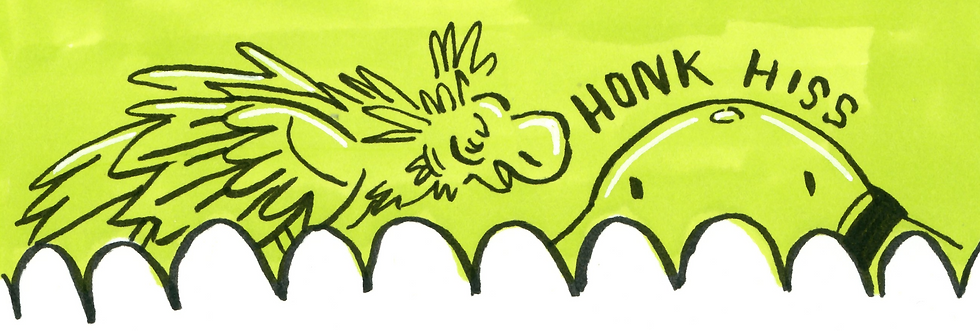
The Sightless Swamp Bird produces a variety of sounds, including honks, hisses, and grunts. These sounds serve various purposes: announcements of food, calls to a mate, signs of aggression, cries of pain, warnings of danger, and cries for help. Nocturnal animals, their vocalizations add to the din of the Glade's nighttime soundscape.
These birds differ from other kinds as they lack a syrinx (the vocal organs of birds); it is unable to create sounds as other birds do, instead limited to mouth and nasal noise-making.
Breakfast/Feeding Song; long, high-pitched whistle = "I am hungry", "I am looking for food"
Small, airy, nasal hiss = "Something smells good", or "Something smells concerning"
Two honks, second more shrill = "Come share food!"
Grunt = "Danger!"
Guttural hiss = "I am going to bite", "I am going to hurt you"

WHAT DOES IT EAT?
Proboscis Birds are facultative scavengers, meaning that they eat carrion whenever it is convenient, but are not wholly dependent on a scavenger lifestyle. With the olfactory lobe and chamber being much larger than in other animal’s brains and noses, they can detect carrion over a mile away.
THE PRICE OF STINK
These animals' foul smell attracts other scavengers. This can be a problem for Proboscis Birds, as the outsiders may steal their carrion or register them as food. If they are personally attacked or feel food being pulled away from them, they may lash out, pecking, scratching, and flapping at the offender. In some cases, a less combative bird, or a flock few in number, may empty their bacteria-laden bellies, regurgitating near the corpse. Usually a defensive measure, the digesting contents’ overwhelming smell and slight skin irritation makes attackers rethink their course of action. For scavengers, though, the substance may pull their attention away from the flock’s food, at least for a time.
MOTION TRAP The birds gain most of their sustenance through foraging for seeds, fruit, roots, and greens. Opportunistic predators, if small prey animals, like mice or frogs, get too close, the vultures will snap them up and swallow them whole. Standing firmly on two legs, incredibly still, they utilize their sensory feathers and hairs. With them, they can detect when a potential meal is near. No matter the size, sound, or taste, if it doesn't smell like one of their kind exactly, and it brushes up against their detectors, they will peck at it. While successful against small creatures, these painful pecks can start altercations with larger, and generally docile neighbors. However, this method is further thwarted by prey animals' ability to learn the dangerous birds' smell and avoid them.

HOW DO THEY INTERACT WITH EACH OTHER?
Proboscis Birds are social creatures in the summer and fall. It is speculated that flocking together during these months is a handy survival instinct; as a group, they are more likely to detect and flee dangers, or face them, when needed. While they do not often directly interact with each other, they seem to enjoy being near to their own kind and individuals are recognized by smell alone.
During the social season, the growing flock eats, sleeps, and begins building and maintaining a nest together. These social activities encourage bonding within the group, and acts as scent reinforcement. This is very important; as the birds familiarize themselves with each other’s scent, they are continually recognized as part of their unit. The less familiar the scent, the more likely the bird can have a negative experience within the flock.
When a community grows too large, the population splits in half, the smaller half relocating elsewhere.
IDENTI-STINK Each bird's scent is a unique blend; while to you or me, it is just the normal stink of a Proboscis Bird, to them, it is the individual's name, associated with details known about them: age, sex, size, personality. This isn't automatic; like making a new friend, these details are learned and gathered over time.
A Proboscis Bird’s smell is not easily removed, but can be tainted by injury, illness, or human interaction. The newer and less familiar the tainted individual is, the more likely it is to be registered as food, or, at least, not a friend, and not permitted to partake in feeding, breeding, or nesting; once this occurs, the ostracized bird’s smell has a chance of always being registered as an outsider’s smell. An unrecognized bird can cause a flock feeding frenzy or mass attack. Birds who distance themselves from a flock that has rejected them may be reentered into the group several weeks later, if whatever has contaminated their scent has been removed or remedied.
GLADE SYRUP
The birds' strong, offensive odor plays a vital role in their lives. The smell emanates from a natural oil produced by the birds, a brown, foul-smelling ooze often compared to the scent of long-rotten eggs. Called 'Glade Syrup', the substance is sticky, collecting loose vegetation, discarded feathers, and other debris, further camouflaging the animal. The unpleasant taste and scent of the oil decentivizes potential predators from making a meal of them, and will ward away those who have tried and had an unpleasant experience.
Not eating enough carrion can hinder the production of the substance. Changes in a bird’s natural diet, such as the introduction of breads, may also negatively affect the oil and its properties.

HOW DO THEY REPRODUCE?
Proboscis Birds do not form individual nests during mating season; instead, they create large communal ones made from grasses, sticks, and other vegetation. These nests are haphazardly arranged but serve as the central hub for the entire group. Laying sites are found near creeks or rivers in thick pockets of mud accompanied by tall grasses.
Reproduction within the group is communal, with no strict pair bonds or monogamous relationships. Instead, mating occurs opportunistically, and any unwanted attention is met with defensive behaviors such as a sharp peck or a flap of the wings.
Males and females share the responsibility of incubating eggs, feeding young, and defending the nest. Members rotate between sitting on the eggs and foraging for food; eggs are incubated for 37 days, are a dull gray, and have a rough shell. Once the eggs hatch, egg-sitting duty is exchanged for regurgitating food to feed the chicks.
Unfertilized or unhatched eggs are eventually eaten once hatchlings emerge.

HOW LONG DO THEY LIVE?
The Proboscis Bird can live up to 10 years under optimal conditions. However, predation and human disturbance can significantly impact and halve their lifespan.

WHY ARE THEY BALD?
Many connect a vulture’s bald head to their scavenging, thinking that having less material there keeps them cleaner and less at risk of infection or illness. That isn’t the case! It is actually an adaptation to conserve or release heat. A hot Proboscis bird will expose more of their bare skin, dumping more heat into the air. A cold bird will tuck in its neck, enshrouding its baldness with its fluffier, body plumage, insulating its body heat.
There is another way birds beat the heat. As they cannot sweat like humans or pant like dogs, to cool off, several utilize a process called urohidrosis (which contributes to their already unpleasant smell). Nearly 97% of birds, including this species, have only a cloaca. Unlike in mammals, every excretable, including eggs, exits from here. To put it simply, many kinds of swan and vulture poop on their legs to cool off. As the liquids evaporate, it takes some of the heat with it, just like sweating. In fact, that’s what urohidrosis means: urine sweat.
Sources
2017 - 2019 West Virginia BCwPA Research Tent In-Person Conversations & Online Correspondence
All About the Turkey Vulture’s Sense of Smell Avian Report: Source
If I handle a baby bird, will the parents abandon it? Cornell Lab: Source
When You Should—and Should Not—Rescue Baby Birds Audubon: Source
Double-banded Sandgrouse Pterocles bicinctus Peter Boesman 2016-11-13
Why do vultures have bald heads? University of Glasgow: Source
A Letter to the BCWPA
Dear Ballyraven,
A lot of people say that if you touch a baby bird, the parents won’t recognize its smell and will abandon it. I don’t think this is true, but I’m not 100% sure. If I’m right, why has it become such a common myth?
Thanks, Birdwatching Bubba
Do you know fact from fiction? What parts of this story are real, or at least pulled from real belief, and what is completely made up?
In the Field with the Sightless Swamp Vulture is based on one key fact and is a lesson on asking questions and thoroughly looking at sources.
If you touch a baby bird, its parents will reject it.
MYTH! This statement is untrue.
Birds generally have a poor sense of smell, relying instead on seeing or hearing to recognize their young. Picking up and placing a baby back in its nest won’t harm nestlings—the bird stage where they look like pink or brown wads of wrinkled skin. Its parents will continue to care for it as usual, no harm done.
Some birds are worse with misplaced chicks than others, but it’s not because of smell. Several species of bird will direct fledglings back to their nest if they fall out, but others, like the Grey-headed Albatross, will only recognize their young if they are physically in the nest, providing no help to get back home.
Explorers of Cranberry Glade
FAKE! This story and creature are completely fictitious; they will not be found in any folk account or sighting dating before 2017.
Was there really a team of explorers that discovered these creatures? Did they really leave journals behind? Did they really nearly decimate an entire species of bird by accident and negligence? Thankfully, no. While you may find information about 18th century European expeditions into the area, you won't find anything about blind, smelly birds or recovered journals. That's because this story and these creatures are completely made up, based only on the saying, "If you touch a baby bird, its parents will reject it."
It isn't hard to believe something like this happened or could have happened - there are many instances in history that are similar. Humans have exterminated (or almost eradicated) species plenty of times, sometimes on purpose, other times inadvertently so. The goals of commercialization has led to many dark outcomes. People also tend to be short-sighted and neglect the needs of animals.
Nevertheless, the Proboscis Bird was partially based on a real species of vulture, the turkey vulture. The fictitious animal, however, is pushed to extremes in both ability and American's perception of them. The Proboscis Bird's diet, defensive regurgitation, temperature/bacteria regulation, scent-hunting, vocalizations, and communal behavior are loosely based on the turkey vulture.


Comments