

- May 14
- 8 min read
This entry is about a figure in Cherokee and Natchez belief. Beings in these stories are often called cryptids, but they are not cryptids. They are not undiscovered animals or elusive creatures, but entities of a spiritual world. I won’t go into too much detail, because it’s outside of my knowledge and experience, but as far as I’ve read, in Cherokee belief, the universe is made up of three parts: the Upper and Under World, where the spirits live, and This World, where humans live, try to maintain balance, and are sometimes visited by beings of the Upper and Under World. Everything, including plants, animals, rivers, mountains, and other parts of nature, are said to have spiritual powers and characteristics.
Here, we’re going to talk about Tlanuwa, the Great Mythic Hawk, as a figure, but not a cryptid. I don’t usually cover stories like this, ones that are tied to religious beliefs, but stories of Tlanuwa have influenced current cryptid subjects, like Pennsylvania’s Chestnut Ridge Monster and West Virginia’s Snaggle Tooth Roc, and are often compared, equaled to, or lumped together with the Thunderbird, living pterodactyls, and large, flying, bird-like cryptids around the Appalachians by cryptozoologists. It is, however, its own thing. So, I think it’s important to talk about and understand, to differentiate. I will be covering three stories I read about the Tlanuwa, as well as some descriptions of them; they will, of course, be missing the context that comes with knowing more of Cherokee and Natchez tradition and spiritual belief.

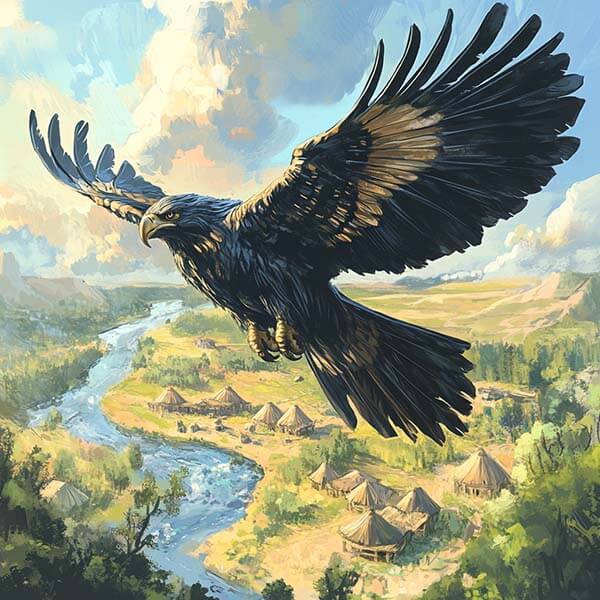
The Tlanuwa is a spirit being of the Upper World that sometimes visits This World. It is a giant raptor–a bird of prey with deadly talons and a carnivorous diet. When I say giant, I don’t mean giant for a bird, I mean giant for anything. Its feathers were described as being about a fathom in length, which translates to about 6 feet. Tlanuwa is similar in appearance to the red-tailed hawk, sometimes described as having copper-colored backs, red feathers, or the same markings as its hawk counterpart. Its feathers act as a kind of armor, reflecting arrows and other attacks; some describe their feathers as being made of metal.
Large and powerful, the Tlanuwa were feared, and for good cause. While their presence offered some protection (beings of the Upper World fought those of the Under World), the Tlanuwa hunted not only evil spirit beings and woodland creatures, but human children, plucking them from the ground as a hawk does chickens.
Our first Tlanuwa story comes from a collection of writings from John Reed Swanton, an American anthropologist, folklorist, and linguist. He worked at the Smithsonian Institute’s Bureau of American Ethnology (which is a field of anthropology) for forty years, during which he recorded “the Tlanuwa” in a book called Myths and Tales of the Southeastern Indians; covering several groups, each chapter is a story told from a surviving storyteller in the early 20th century.
It begins with a quote from the story’s main character, a nameless young man. He says, “If I had children and those birds took one of them, I would kill them.” Though people told him not to say such things, he ignored them and kept doing it anyway.
Years later, his life had changed. One day, when he was away hunting and his wife busy cleaning, his child was running around and playing in the yard. Out of nowhere, a Tlanuwa flew down, grabbed them, and soared away. When the man returned home, his wife told him what happened. He wasn’t angry, but decidedly said, “I’m going to kill him.” So, for seven days, he laid down and fasted.
The man was not the first to try and kill Tlanuwa. People had tried to shoot the bird with arrows, but Tlanuwa caught the shots mid-air as it flew; he was going to try something different. After his fast, he went to a nearby river and dove into it, catching a turtle. Then, he climbed up to the very top of the tall, dangerous cliff the bird’s nest was built on. Using a grapevine, he tied the rope to the clifftop and swung down to the ledge below, where the Tlanuwa nest sat. Next, he tied the turtle to the end of the grapevine and hung the animal in front of it. Inside the nest were some young Tlanuwa; he killed them and threw them over the edge, in the water. Returning to the top of the cliff, he hid and waited for the birds to return. Eventually, he saw two of them in the distance; one carried an infant in their talons. Sensing something was wrong, they circled the cliff, but didn’t land. The Tlanuwa flew high in the sky and dropped the child; it tumbled against the rocks, beat into pieces before reaching the ground. The birds then dived into the water, pulling out a snake. The Tlanuwa carried it high into the sky and dropped it as they had the child; the snake broke into several pieces and fell into the water. Then, one of the Tlanuwa flew to attack the turtle, but instead, the bird broke a wing on it, falling down the cliff and into the water. Its mate did the same.
Afterward, the man returned to the Tlanuwa nest, untied the turtle, and released it where he had caught it. Swimming to the other side of the river, where the bank was lower, he made a canoe and retrieved both Tlanuwa from the water. He stripped them of their feathers and made a box to put them in.
Later, more Tlanuwa came. These ones, though, were red. They landed on a tree near the man; he shot one of the birds, killing it. As before, he stripped this Tlanuwa of feathers and put them into the box with the others. Once he did so, several people in his town began dying of a bloody flux–which is an old word for fluid flowing from the body, like dysentery or diarrhea. The man thought that the red feathers must have caused the illness, so he took them and threw them into the water, and the disease abated. According to the story, the person who saw these feathers was Watt Sam’s–a Natchez storyteller, cultural historian, and one of the last two native speakers of the Natchez language–great-great-grandmother.
Our second Tlanuwa story is called “the Nest of the Tlanuwa,” written by ethnographer James Mooney. Like John, James worked at the Bureau of Ethnology for nearly 40 years, studying Southeastern Native Americans. In the late 19th century, he traveled with the Eastern Band or Cherokee, listening and recording their stories in their own language, later translating them to English in the 1902 book, Myths of the Cherokee.
This time, the story begins in a specific place: a high cliff that hangs over a creek, Citico Creek, to be exact, a bend in the north bank of the Little Tennessee River, in Blount County, TN. The tall, rocky feature has two openings halfway up its face, a seemingly impossible to access cave. Above the cavern entrances are outward-projecting rocks, concealing the cave from those standing on top of the cliff; below, streaks of white stain the stone from cave mouth to the water’s edge. This area is called the place of the Tlanuwa.
Long ago, soon after the creation, a pair of Tlanuwa made a nest in this cave. The white streaks left behind on the cliff are signs of their life–droppings from their nest. The Tlanuwa were gigantic creatures, larger than any living bird, incredibly strong, and vicious. The couple was always seen flying up and down the river, sometimes swooping into nearby settlements and capturing dogs and young children playing by their houses. However, no one could reach the Tlanuwa’s nest and stop them. People tried to shoot them, but the arrows glanced off of their body, were caught by the birds’ talons, and carried away.
Unable to do anything about the Tlanuwa, the people sought the help of a medicine man. Not everyone was hopeful that he would be able to help; in fact, some thought that if he tried and failed to kill the birds, they would retaliate with a vengeance. The medicine man assured them that he could help and fix the situation. First, he made a long rope of linn bark; he put two loops in it for his feet. Then, when he knew the birds were out of the cave, he had the people lower him down the cliff side and under its ledge. Even when lowered directly across from the cave mouth, though, he couldn’t reach it. Swinging himself back and forth, once he got close enough, he used a hooked stick to catch some bushes that grew around the hole, pulling himself inside the cave. Inside, there were four young Tlanuwa inside a large nest and a mass of scattered bones from several different animals on the floor. He threw the young birds over the cliff edge and they fell into the deep water below. A great serpent named Uktena, a being from the Under World, surfaced and ate the hatchlings. Just as the snake snapped them up, he saw two Tlanuwa flying towards the cliff in the distance. He barely climbed back up to the top of the cliff before they reached their nest.
Once seeing their children gone, the Tlanwua were furious. They took flight, circling the area until they saw the snake stick its head out of the water. They darted towards the serpent; one Tlanuwa grabbed the snake in his talons and brought it high in the sky; its mate attacked it, pecking bits of its body piece by piece, until nothing was left. The birds had flown so high up, that as the snake chunks fell to the ground, they made holes in the rock opposite to the mouth of Citico Creek, which may still be seen today and are called Where the Tlanuwa Cut It Up. The two Tlanuwa circled, flying higher and higher, disappearing. They haven’t been seen since.
- - -
The third story comes from the same book and is called “the Hunter and the Tlanuwa.” An unnamed hunter is out in the woods one day, when he spots a Tlanuwa overhead. He tried to hide from it, but the bird had already spotted him. Swooping down, the Tlanuwa grabbed his hunting pack with its claws, carrying him high into the air. The bird told him that he shouldn’t be afraid; she wasn’t going to hurt him, but needed his help. The bird was a mother and her young needed protection. Bringing him to her nest, which was tucked away in a cave set inside a steep cliff, she asked him to stay for a while and guard her children until they were old enough to leave the nest.
The cave was wet and water dripped from its roof. Further inside was a nest of sticks; two young Tlanuwa were inside of it. Setting the hunter down, the old Tlanuwa left. Soon, she returned with a deer; she tore it into pieces, feeding the hunter first, then her two young.
The hunter stayed in the cave for many days; the birds were now almost fully grown. Every day, the large Tlanuwa would leave in the morning and return in the evening with meat, a bear or deer, always giving the first piece to the hunter. However, the hunter grew more and more uneasy each day. The bird kept telling him to wait a little longer and not to worry, but he did anyway. Finally, he decided to make an escape. One morning, after the old bird had gone, he dragged one of the young Tlanuwa to the cave’s mouth and tied himself to one of its legs with a strap from his hunting pack. Then, with the flat side of his tomahawk, he hit it several times in the head until it became dazed and helpless. He pushed the bird off the cliff, pulling himself off the edge with it.
The hunter and Tlanuwa fell far and fast, but the air below held up the bird’s wings. It was almost as if they were flying. Not long later, the young bird stirred. Waking up, it tried to return to its nest, but the hunter hit it again until it fell unconscious. Landing on top of a poplar tree, the hunter unfastened the leg strap and let the bird fly away, pulling a feather from its wing first. The hunter climbed down the tree and went home. When he got back and looked in his hunting pack for the feather, he found a stone instead.
Sources


“Red-Tailed Hawk.” Cornell University, 2017. Accessed 4 Dec. 2018.
“Hawk Symbol.” Siteseen Limited, Nov. 20, 2012. Accessed 3 Dec. 2018.
“Red-Tailed Hawk.” Cornell University, 2017. Accessed 4 Dec. 2018.
“How Tlanuwa Defeated Uktena.” Arkansas Archeological Survey, 27 Feb. 2007. Accessed 3 Dec. 2018.
Guiley, Rosemary Ellen. “Monsters of West Virginia: Mysterious Creatures in the Mountain State.” Stackpole Books, 1 Mar. 2012


Comments